Saturday 23rd February - Thursday 21st March, 2012
Once again, it's taken a while to get back to the blog. I guess things have been relatively slow in terms of new pictures and that has held me back. However, the birding has been pretty good and signs of Spring are definitely here, even though the last week has seen a further cold spell and more snow. Ironically, as I look at my choices for new photos, I find I may actually have more than I thought, so here goes...
...starting back in February with an improved variety and number of birds on my feeders. White-breasted Nuthatch has always been regular, but I now get the occasional Red-breasted Nuthatch as well. These two are clearly different but you may be surprised to know the Red-breasted Nuthatch is only the size of a chickadee. Both these birds are males, showing black rather than grey crowns.
 |
| White-breasted Nuthatch (male), Kingston, ON |
 |
| Red-breasted Nuthatch (male) |
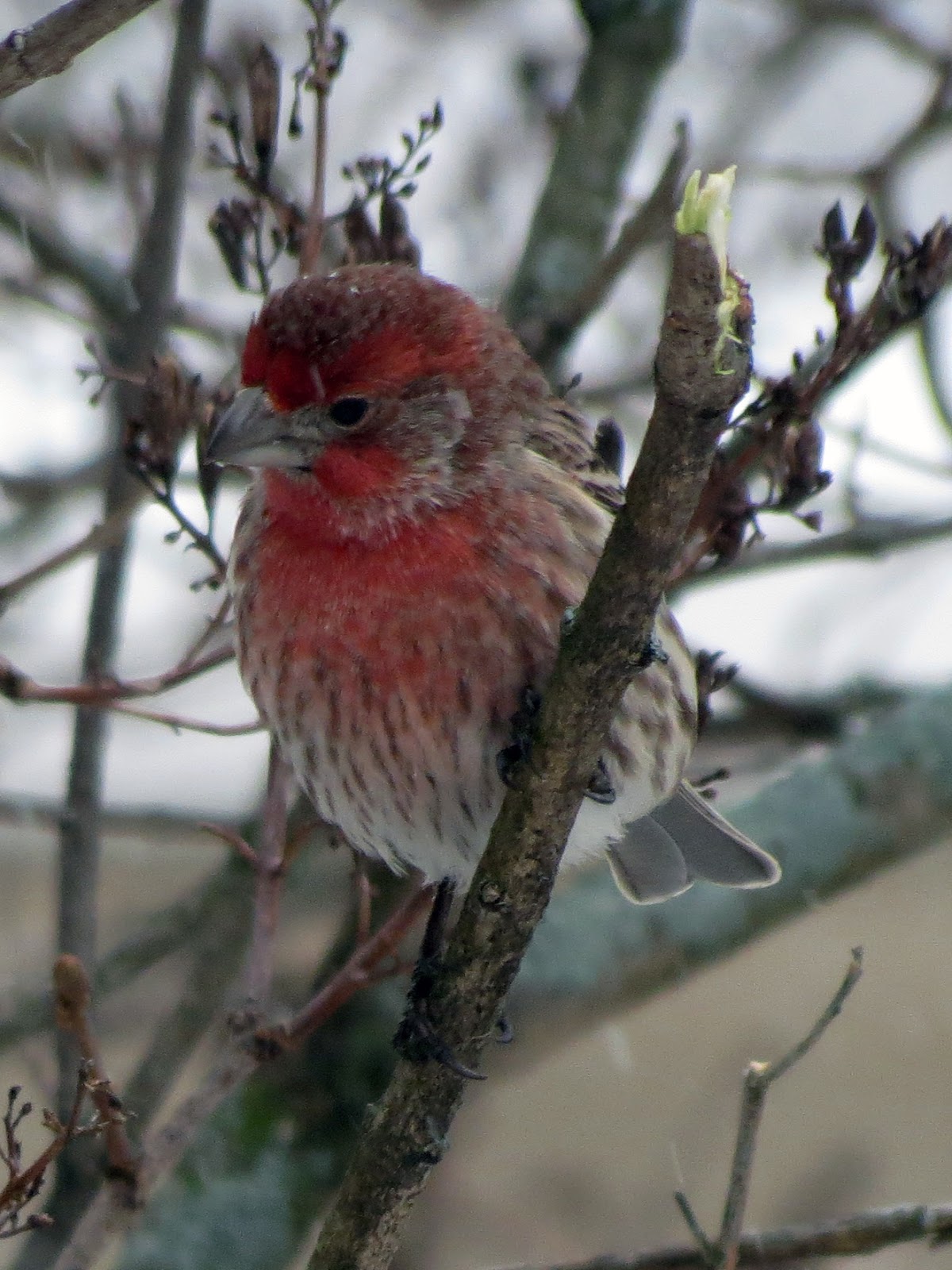
Likewise, Downy Woodpecker is occasional, with the odd Hairy Woodpecker putting in an appearance too. I talked about woodpecker ID in the last post, so to see them both on the feeders has been great. House Finch (actually a type of
Carpodacus 'rosefinch') is here most days too, along with Dark-eyed Junco and, of course, Black-capped Chickadee. The male House Finch has vivid red on its head and upper chest. The female lacks this colouration and is quite heavily streaked on the flanks. Juncos are easily the commonest seed-eater in the garden. They have distinctive dark grey (male) or brown (female) upperparts, white bellies, white bills, and white outer-tail feathers that are easily seen in flight.
 |
| House Finch (male), Kingston |
 |
| Dark-eyed Junco (male), Kingston |
At the end of February, I was informed that the roads around 'DuPont Lagoons', now owned by Invista, are actually accessible to birders and dog walkers despite all the 'no entry' signs. This was good news for me as the site is only half an hour's walk from the house and the water stays open all winter due to, I assume, warm water coming out of the factory. My first trip there provided a lifer in the form of Redhead, a duck species superficially very similar to the European Pochard. As well as many other common wintering ducks, I picked up an immature White-crowned Sparrow and a cracking pair of American Kestrel - both new for the year. Since this first visit, the lagoons have yielded other goodies such as Wood Duck, Greater Scaup and Hooded Merganser, though now that Lake Ontario is mainly unfrozen, the typically high concentration of Mallard, American Black Duck and American Coot has dropped right off.
 |
| American Kestrel (male), Invista, Kingston |
I have also started seeing a few mammals, though these have been much harder to photograph. Invista has yielded Musk Rat and a mating pair of River Otter. A Red Fox was seen near its den in Lake Ontario Park chased, unfortunately, by a dog let off its lead by an irresponsible owner. I certainly shared my views with that particular dog walker. I have also seen a few Eastern Chipmunks, as well as two 'new' mammals, North American Porcupine and Raccoon - the latter in my garden. However, the only mammal I managed to photograph is this White-tailed Deer, seen at another new location for me, Lemoine Point Conservation Area.
1+-+Lemoine+CA,+Kingston,+ON.JPG "White-tailed Deer (female), Lemoine Point Conservation Area, Kingston, Ontario, Canada") |
| White-tailed Deer (female), Lemoine Point Conservation Area, Kingston |
Lemoine Point Conservation Area is a large 136 hectare area of forest, marsh and grassland near the airport, just west of the city. I first visited it on a Kingston Field Naturalists meeting in early March where I finally got to meet some of the local birders. The time of year didn't help with bird sightings but I have managed to get back once more and picked up my first 'true' Spring migrants, Common Grackle and Red-winged Blackbird. These two species now seem to be in every bush and garden and have even been investigating my feeders. The following two pictures were actually taken at another location, the Old Davis Tannery in Kingston's Inner Harbour. The grackle has a white stain on its tail - a gift from another bird.
 |
| Red-winged Blackbird - Old Davis Tannery, Kingston |
 |
| Common Grackle - Old Davis Tannery, Kingston |
My second trip to Lemoine Point also allowed further sightings of White-tailed Deer, which it turns out are quite tame. I guess they either get fed or have taken to foraging around the bins and car parks. I was also lucky enough to see this female Ruffed Grouse pretending to be a dead twig high up in a bush. Fortunately it's disguise didn't fool me and I got a couple of interesting shots before it gave up and noisily flew off through the undergrowth.
2+-+Lemoine+CA,+Kingston,+ON.JPG "Ruffed Grouse (female) - Lemoine Point CA, Kingston, Ontario, Canada") |
| Ruffed Grouse (female) - Lemoine Point CA, Kingston |
I have been doing a fair bit of birding in Kingston's Inner Harbour, particularly since the ice has melted. My first returning ducks were Green-winged Teal, spotted on the only open patch of water in early March. Since then American Wigeon, Ruddy Duck, Pied-billed Grebe and Hooded Mergansers have all returned. Large numbers of Lesser and Greater Scaup have also been present, with a fair number of Common Goldeneye, Long-tailed Duck and a few Bufflehead. These birds normally seek more open waters but the scaup have been putting on quite a show at both the Inner Harbour and my local patch, Portsmouth Olympic Harbour.
 |
| Green-winged Teal (male) - Old Davis Tannery, Kingston |
 |
| Long-tailed Duck (male) - Portsmouth Olympic Harbour, Kingston |
 |
| Tundra Swan - Old Davis Tannery, Kingston |
The Tundra Swans pictured above are the same species as Europe's Bewick's Swan. This Nearctic subspecies is often called Whistling Swan (Tundra Swan covers them both) and shows very little, if any, yellow at the base of the bill, whereas the Bewick's shows quite a large round patch. In fact, on these birds, I could barely pick out anything more than the slightest hint.
It has been fantastic to see so many scaup lately, and often close to shore. Apparently Greater Scaup is the commoner of the two species in this area, but earlier in the month this was reversed and I was seeing between 150-200 Lesser Scaup in the Inner Harbour, with just a handful of Greaters. Since then the number of Greater Scaup has increased - a couple of days ago I had over 500 at Portsmouth Olympic Harbour, with only 30 or so Lessers in with them. Head shape is one of the key features to separating the two species, along with Lesser's smaller size (tricky), a noticeable greyish wash to the white flanks and according to some a more purplish, rather than green, iridescence to the head. I didn't find this latter feature to be very helpful at all, and at times even head shape was difficult to judge. In flight, Lesser Scaup can be told from Greater Scaup by a much shorter wing bar that does not extend into the primaries. Can you see the difference?
 |
| Greater Scaup (male and female) - Portsmouth Olympic Harbour, Kingston |
 |
| Greater Scaup (male and female) - Portsmouth Olympic Harbour, Kingston |
 |
| Lesser Scaup (male) - Portsmouth Olympic Harbour, Kingston |
This Lesser Scaup shows a more peaked crown that is flat at the back of the head, a small black tip to the bill (slightly larger in Greater) and distinctly greyish flanks (compared to the crisp white of Greater). While seeing these birds so close has been great, it does highlight the challenge of more distant birds, which may have to be left as simply 'scaup sp.'
To speed things up a little, here are a couple of the 700 Bohemian Waxwings that showed up for a day early in the month...
 |
| Bohemian Waxwing - Portsmouth Olympic Harbour, Kingston |
...one of the many Ring-billed Gulls that grace the harbour walls,
 |
| Ring-billed Gull - Portsmouth Olympic Harbour, Kingston |
and two shots of American Robin. I can see why 'robin' springs to mind, but just get over it - they're thrushes, and real cracking ones at that too.
 |
| American Robin - Marshlands Conservation Area, Kingston |
 |
| American Robin - Marshlands Conservation Area, Kingston |
Finally, I come to the end with a brief account of a very enjoyable morning over on Wolfe Island earlier in the week. I went with a fellow birder, Paul, who kindly picked me up at home. His main goal was Lapland Longspur (Lapland Bunting) and, good on him, we found a male coming into breeding plumage within minutes of being on the island. It was associating with a flock of 20 or so Horned Larks (Shore Larks) but unfortunately didn't hang around for long. Horned Larks turned out to be quite numerous as we progressed around the island and we also got to see perhaps 45 Snow Buntings too. We later found another flock of 8 Lapland Longspur. Here are four of them for you, with a closer shot of the male just below.
 |
| Lapland Longspur, Wolfe Island |
 |
| Lapland Longspur (male), Wolfe Island |
And so to the subject of this post - a Canadian Goodie. At long last I've seen a Snowy Owl. Yes, I did see one on Ben Macdui in the Cairngorms, Scotland back in the 1987 but that is some time ago! This one was also much easier; it was sitting on a telegraph pole right beside the road!
 |
| Snowy Owl, Wolfe Island |
Other highlights and additions to my year list included a male Northern Harrier, Northern Shrike, and the year's first Killdeer. Back on the mainland, at Violet Dump, we also had three Iceland Gulls, a first winter, a second winter and adult winter. For the gull watchers out there, this was actually Kumlien's Gull, a subspecies new to me and therefore very agreeable despite the bitterly cold northerly wind whipping across the open landfill. Thanks Paul for a great morning.
Till next time...
Mark.




1+-+Lemoine+CA,+Kingston,+ON.JPG "White-tailed Deer (female), Lemoine Point Conservation Area, Kingston, Ontario, Canada")


2+-+Lemoine+CA,+Kingston,+ON.JPG "Ruffed Grouse (female) - Lemoine Point CA, Kingston, Ontario, Canada")


.JPG "(Eurasian) Griffon Vulture? Dhangadhi, Kailali, Nepal")
.JPG "(Eurasian) Griffon Vulture? Dhangadhi, Kailali, Nepal")

